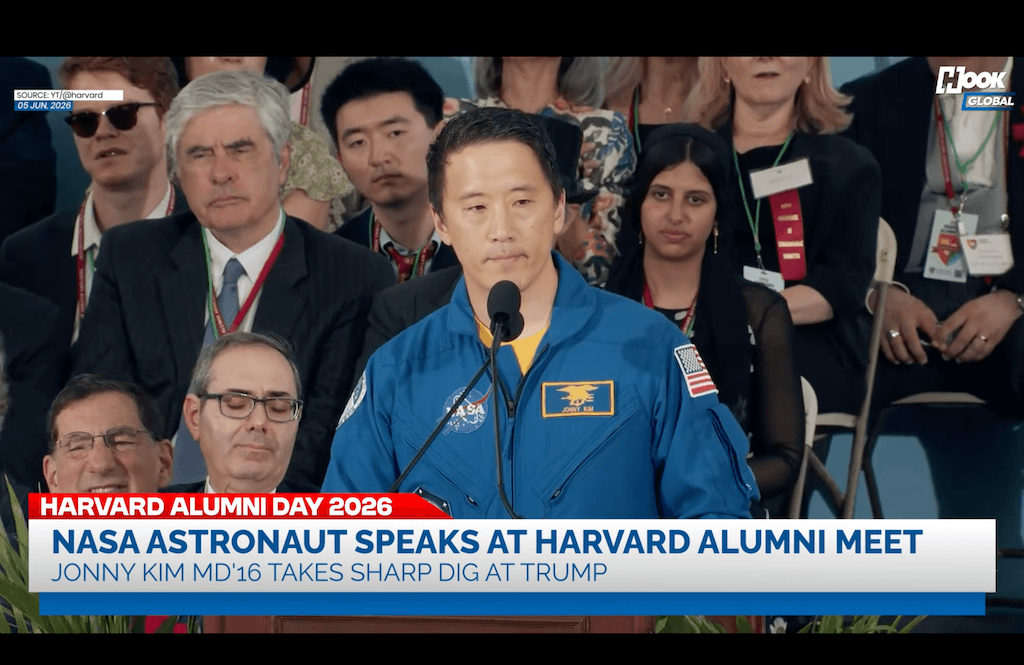
Most speeches are forgettable. This one wasn’t.
Jonny Kim’s recent address at a Harvard alumni event was one of the best speeches I’ve ever heard. Former Navy SEAL. Emergency medicine physician. NASA astronaut. In 15 minutes, he tied together war, medicine, space, grief, and love into something that felt necessary for this time.
Watch it if you can. Worth every minute.
No borders from up there
Kim spent time on the International Space Station and experienced what astronauts call the “overview effect.” From that altitude, you don’t see nations. You see one fragile planet.
He puts it plainly:
“Yet through it all, I never saw distinct borders. I just saw a fragile, beautiful planet suspended in the darkness of our solar system. The overwhelming realization that everyone you have ever known and will ever love shares the same spaceship we call Earth.”
Not a new idea. But there’s a difference between reading it in a book and hearing it from someone who has actually looked down and seen it. The weight shifts.
What service actually looks like
A lot of the speech is about service. Not the polished version people put in bios. The real, unglamorous kind that doesn’t photograph well.
He strips it right back:
“True service isn’t about the uniform you wear, the title you hold, the altitude you reach. It is simply about the person next to you.”
Coming from someone with his background, that’s not humility for the crowd. That’s someone who tested the idea in extreme conditions and arrived at a simpler answer.
The solo hero thing
Kim grew up, like a lot of us, idolising lone heroes. The incorruptible, self-reliant type. That image even shaped his decision to become a SEAL.
Experience corrected it fast:
“In the extreme environments I’ve spent my life as an adult, I learned that the solo hero myth is dangerous.”
On the battlefield, in emergency rooms, in space, survival isn’t about being invincible:
“Whether you’re relying on the marine next to you in a firefight, the nurse during a code blue, or your crew mates in the vacuum of space, survival demands absolute trust in others. True strength is found in recognizing you cannot do this alone.”
The real superpower isn’t self-sufficiency. It’s knowing you need people.
Owning a mistake that cost a life
This is where the speech gets hard to sit with.
Kim describes a decision he made in combat, made with the best information available, made to protect his unit, that took a life. He doesn’t soften it. He doesn’t reach for context as cover:
“Operating with the information I had and with the absolute intention of protecting my unit, I made a decision that took a life and I was wrong. …I’m not the victim of this tragedy. I caused it. And it’s a weight I rightfully deserve to carry for the rest of my life.”
What followed wasn’t collapse. It was redirection. That weight pushed him toward medicine, then toward space. Not despite the mistake, but because of what he chose to do with it.
Taking the armour off
You’d expect someone with Kim’s background to talk about toughness. Grit. Resilience. The usual things people say on stages.
Instead, he lifts up empathy and vulnerability:
“Empathy and vulnerability are superpowers that can heal.”
And then:
“True superpowers don’t require us to put armor on. They require us to take our armor off.”
It’s the overview effect at a human scale. If looking at Earth from space shows you our shared physical existence, empathy is how you see the emotional one.
Who loyalty is actually for
Kim also reframes what loyalty means. In the SEAL teams, brotherhood tends to be treated as unconditional. You protect each other, full stop.
But unconditional loyalty to fallible humans has a ceiling:
“Our unconditional allegiances are best reserved for our shared ideals, to moral and ethical values, to veritas, and if of faith, to God.”
Small shift in framing. Significant in practice.
Jonny Kim on AI (and what it can’t replicate)
One moment hit differently given the current climate.
“No matter what new technology comes our way or how much AI takes over, there is one thing that it will never be able to replicate. Integrity. Humility. Trust.”
Not skills. Not outputs. Character. Who you are when nobody is watching, and how you treat people when things get difficult.
The part that actually got me
Kim ends by talking about his mum.
After spending the whole speech on fictional heroes and larger-than-life figures, he lands here:
“If you ask me today who my superhero is, I’d say my mom.”
A woman who faced life, business, and health challenges with a strength that rivalled anyone he’d trained alongside. Who, despite every reason to become guarded, stayed open:
“Despite having many reasons to be cold to a world that was sometimes unkind to her, she remained compassionate, generous, and above all, morally courageous.”
He lost her to cancer about a month before this speech. Then:
“And my whole life, I’ve looked to fictional characters or out into the world for heroes to emulate when my biggest superhero was always right there by my side.”
And directly to her:
“Mom, I love you and I wish I had told you that you were my superhero.”
My mum was my superhero too. She carried things most people never saw, made sacrifices that shaped my entire life, and did it without needing anyone to acknowledge it. Hearing Kim say those words, with the weight of love and regret behind them, felt like he was giving voice to something I’d carried quietly for years.
What Jonny Kim leaves you with
He doesn’t end in reflection. He ends with a call:
“Be the superhero you wish to become.”
And grounds it in the everyday:
“Depart to better serve thy country and thy kind. Always lead with your heart. Take off your armor. Exercise empathy, especially towards people you disagree with. It is the only path by which we can coexist, leaving this fragile, beautiful spaceship we call Earth better than we found it.”
Not complicated. Just hard to actually do.
Watch the speech. Give it 15 minutes.